After I learned that my grandfather died I realized I hadn't taken my medicine. Cue what was probably hours of looking for the most important medicine. In the end I had to partially dismantle my couch, but I am medicated now. By the time that was over I had to take a shower.
Now I'd like to do something light. Something fun. Perhaps even something silly.
So, the Lynnverse:
Lynn lives two lives, sort of. Not in a putting on spandex and a mask kind of a way, but the fact of the matter is that there's a world of difference between what she does that takes her away from Centerville and what she does in Centerville.
Lynn runs a website for kids, teenage and younger, who need a hand. She likes the song "Lean On Me" by Bill Withers. Well, she likes Bill Withers in general, but "Grandma's Hands" isn't exactly emblematic of what she does.
Something that she didn't really account for when she set up the site was that the internet being what it was meant that anyone on earth could contact her. When she's called she comes and provides what help she can. Sometimes this means trading favors to get a ride. Sometimes this means stowing away on something going in the right direction. By now she's been around and done a lot.
She doesn't try to save the world. Honestly. If someone contacts her looking for help recovering a stolen nuclear weapon then she'll forward that request to her aunt Simone because that's not what Lynn does. If, however, a kid contacts her because strange people have been keeping them out of their favorite play place using scary bullying tactics and that just happens to result in her spelunking through a limestone cave following terrorists who have stolen a nuclear weapon and are trying to use the cave system as a way to smuggle it passed the surface level government agents --who are trying to quietly (they don't want to cause a panic) recover the weapon by setting up a perimeter with giger counters and find the weapon by tightening the perimeter until they find the weapon-- well then of course Lynn will recover the weapon and turn it over to the proper authorities.
First off, it's just basic manners. Second, that kid isn't going to get to play in those caves again until the terrorist goons are out of them.
In her role as helper outer Lynn puts on different clothes and, to an extent, a different personality. She's more outgoing, for one thing. The people she meets haven't judged her, they don't know the climate of Centerville or where she falls in the social structure. It's ... easier.
It also lets her put her brain to use the way it seems to want to be used. She's good at solving things. Give her a mystery and she'll eventually put the pieces together no matter how complicated it is. She can duke it out with bad guys, but she prefers to out think them.
In Centerville itself Lynn would be a pariah if the powers that be of the teenage world got their way. Unfortunately for said powers, she has eight whole friends. Her two best friends are Sun and Zee. Christy and Ashley made friends with Lynn, Des and Rachel she met through Zee, and Rob and Nick she met through Sun. By now all nine are a pretty tight knit group.
All of them form the brain trust of Lynn's team for helping people who contact her via her website, but usually only Sun actually joins her in the field.
Lynn generally tries to be invisible in Centerville. It never works.
She isn't the student who's bullied the most, but she often gets "accidentally" bumped into, often hard enough to send her to the floor, and she's been called names that she wouldn't repeat.
It's a struggle to maintain good grades because helping people takes time and that cuts into study. She never planned to so much as consider extra curricular activities but she eventually joined the debate team with Zee.
Her clothing tends to be drab and cover every part of her but her hands and head, she's been known to rock a faded hoodie.
The fact that she could beat up the kids who bully her doesn't provide any comfort at all. Not that she'd expect it to.
Her mother works in Washington. Sort of. She's usually not paid and she often lives out of her car. She's been able to get the trust and respect of some movers and shakers, occasionally works as an unofficial adviser instead of her usual role as advocate and sometimes even gets to go on trips with House members and Senators. (Or, in other words, I was totally for stealing the idea of Teenage world saver has a Senator for a mother but with the pay at $174,000 a year I'd have had to drop Lynn's poverty or find a way for 90% of that income to be spoken for, which would requires some really massive debt.)
Sometimes Lynn (and sometimes even one or two of her friends) gets to tag along.
Lynn's father does super secret confidentiality protected stuff for a food company. His creations make his company billions. That doesn't actually help him since his minuscule paycheck isn't tied to performance. Lynn thinks he should feel cheated by that. He's just happy to be able to work at a state of the art lab.
Lynn, with help from her friends, is able to make great use of technology borrowed, stolen, copied, or so forth from his lab. Some hits include the frosting mine (distributes cake frosting over an entire surface when detonated; great for making groups of enemies slip and fall), the sherbert ray (it's a tasty freeze ray), the ice cream launcher (single scoop, short range), the snow cone launcher (long range, does not launch cones, just spheres), the banana creme concussion grenade, pixy bombs (Pixy Stix smoke bombs), and ... I've run out of random crap to stick in here.
He's a white boy named "Sun" whose twin sister is named "Moon"; he never expected to fit in.
Sun's parents were raised on a commune and left to find themselves. Eventually they found themselves in Centerville because they were drawn to the idea of attempting to create paradise on earth without withdrawing from the wider world. The commune has been too isolated for them.
Long before they arrived, before there was a Centerville, it became clear that Moon wasn't really cut out for city or town life. She's back at the commune being raised by her grandparents with help from various others. Sun misses her but generally doesn't talk about it.
While religiously the family is somewhere between secular and an extremely watered down new agey mishmash, they still observe Rosh Hashanah and Yom Kippur as a way of paying respect to their ancestors.
Sun and Lynn met Sun's second time in preschool. They haven't been side by side since then, as Sun's parents hadn't found where they wanted to settle down yet, but they always stayed in touch and they usually had their summers together.
It was Lynn's parents who told Sun's about the Centerville experimental utopian settlement project.
Keeping Sun in preschool for an extra year didn't improve his social skills or make him a better student, but since all of his classwork is designed from someone with a brain one year less developed than his own ... he's generally able to slack off and still get good grades.
Sun tries not to let anything get to him, projects a persona of a clumsy doof in spite of his time with Lynn giving him skills that would be well suited to a variety of athletic pursuits, and generally gets by by being the class clown. Apparently it's a mostly protected position which means that he doesn't have to worry about bullying as much as some and can even run interference for some of his friends.
When he's off lending a hand with Lynn he functions as someone she can bounce ideas off of when they're investigating, and a way to keep opponents attention divided in a fight.
The first is important because while Lynn is great at finding the pattern hidden in scant clues, she's always at risk of seeing patterns that aren't really there and chasing after pareidolia.
The second is a bit complicated. Sun will gladly be the distraction to take attention off Lynn, but sometimes people recognize what he's doing and ignore him, in which case he'll do the vital work while she's the real distraction. It's a complicated act of reading the room, but he and Lynn have a pretty good handle on it.
Zee doesn't know how to not care. She cares about everyone who is mistreated and she can't turn it off. She fights for everyone and everything to the best of her ability. This . . . works out about as badly as you'd expect.
One high school student is not going to solve racism, sexism, misogyny, hunger, homelessness, poverty, indigenous peoples being treated like shit, the many and varied bad things being done to the environment, exploitation of less developed areas, income gaps, wealth inequality, homophobia, transphobia, ordinary bullying, cyber bullying, a fucked up tax code, unequal access to education, healthcare, and other basic needs, mistreatment of the mentally ill, discrimination against minority religions ... can I stop now?
She's kind of . . . gloomy. She's plugged in, she knows what's going on, and is painfully aware of how little she can do to make things better. But she keeps on trying make things better none the less.
Her approach toward life can be described as somewhat akin to Chaucer's definition of "Trudging" in the movie "A Knight's Tale":
To trudge: the slow, weary, depressing yet determined walk of a man who has nothing left in life except the impulse to simply soldier on.
She knows that she's not going to win, she knows that the world won't become a good and happy place. She does what she can do anyway.
She met Lynn when she saw Lynn mistreated, she meets a lot of people that way. Lending support when people are down will do that. Only a handful of those people have become her friends.
Zee's was raised, with her older brother and sister, by her mother. With her siblings off at college now it's just herself and her mother in the house. Zee's mother is intensely proud of her.
Of all of Lynn's friends, Zee is the most in tune with Lynn's mother since both she and Zee work trying to make the world a better place for those less fortunate than themselves.
Christy is popular. Christy is a cheerleader. People can't figure out what the Hell Christy is doing hanging around with Lynn.
Christy actually met Lynn the same way as Zee. People were being mean to Lynn, Christy tried to help Lynn out. They got to know each other, they became friends.
She and her brother (less than a year younger than her) were raised by their father. Her brother looks up to her and wants to be an athlete like her. (Though he has his sights set on soccer instead of cheerleading.)
Compared to some of her friends she knows that her life is pretty charmed, but she doesn't know what she can do to help her friends other than being there for them.
She happens to be a lesbian, though she isn't really aware of it at first.
Her oldest friend, and the crush that led to her figuring out her sexuality, is Ashley. Given that Ashley's straight, nothing really came of that. She's actually glad that nothing changed, she was afraid that Ashley would stop being her friend.
Ashley could probably be as popular as Christy, but she has no desire to be. Unlike Zee she doesn't make a point of spurning the school's social structure, but she doesn't really participate either. She just kind of fades into the background and doesn't get noticed. She likes it that way.
She's one of the best players on the soccer team.
She met Lynn through Christy and the rest through Lynn.
One of the reasons she likes to blend and keep to herself is that she doesn't want anyone to ask about her past. She was raised by her two mothers until one of them died. That was before moving to Centerville. She knows better than most of the group how precarious of a situation gay people are in. Her mother could be fired for not being straight, if anyone finds out, because that's completely legal where they live.
When Christy comes out to her, Ashley will show Christy a small shrine to her dead mother kept in an easily locked closet. Christy will be the first person other than Ashley and her live mother to see it.
Ashley has an older sister that I've misplaced my notes on. Wait, no, older brother? Have to find those notes.
Anyway, Ashley helps Christy's younger brother on his soccer game.
Rob's life generally sucks. He loses himself in fictional worlds because apart from his mother and his friends there's nothing for him in this one. He has an older sister and younger brother who both pick on him, his father encourages them to because Rob is a "disappointment" for not being an athlete, his mother will never stand up to his father, and at school things are just as bad.
His closest friends are Sun and Nick but he can't be goofy like Sun, and he lacks whatever magic Teflon coating has allowed Nick to avoid bullying.
He cannot shake the label of nerd. The fact that he likes sci-fi, video games, and sci-fi video games doesn't help. Nor does the fact that he's naturally good at math.
If he had Nick's glasses he'd fit his classmates stereotypes perfectly.
Nick has better social skills than Rob or Sun, maybe that's why people leave him alone. Even though he and Rob have the same interests more or less point for point, the attacks never come. He's able to fade into the background like Ashley and float through the school untouched.
He happens to be bisexual, but he's got no plans on telling anyone that any time soon.
He's the oldest of three boys, his younger brothers like usually him, and his parents are loving and engaged.
All of which makes him think that life is incredibly unfair because he sees everything that Rob has to deal with.
He'd trade places with Rob in a heartbeat because he'd rather be hurt than see a friend in pain and Rob is constantly hurting. Of course Rob would trade right back for the same reason.
Des doesn't know a thing about being Vietnamese. You kind of have to start with that. Des' mother was born soon after her parents moved immigrated to the United States and spent much of her life trying to fit in even though she knew as well as anyone that she never would.
Strongly assimilationist, Des' mother put constant effort into being "normal" in a time and place where "normal" excluded her by default and no amount of effort could change that. She made no attempt to preserve, or even understand, her ancestral culture and when she had a daughter she did nothing to pass on that culture.
She picked the name "Daisy" because she thought that it was poetic, beautiful, and
American.
As "Daisy" grew, her mother was glad to see how many of her features took after her father since they would help "Daisy" fit in and who could want more than that?
And that's probably why Des and her mother don't understand each other in the least.
Sunny days hurt Des' eyes. Bright colors are unnerving and she's loath to wear them. Too many smiles make her want to run for the hills. Centerville's modern aesthetic makes Des long for stone buildings with flying buttresses. The name "Daisy" makes her want to gag. She renamed herself "Desdemona".
Des didn't know what it was to love reading until she read Shelley. She can quote
Frankenstein: or, The Modern Prometheus from memory and is quick to point out that
Frankenstein was the scientist (the monster was never christened but is generally known as "Adam".) Beyond Shelley she reads things like Radcliffe, the Brontë sisters, Roche, Parsons, Alcott, Gaskell and so forth. She loves the fact that female authors were able to shine and make an entire genre their own even though they were living in the 18th and 19th centuries.
She wants to write Gothic herself one day.
And this would all make sense to her mother if not for one unmissable fact: Centerville doesn 't have a goth subculture. At all.
If Des embraced these things to fit in, then her mother would understand. But Des doesn't fit in, she stands out. And so there is a complete lack of comprehension.
In spite of that Des' mother did support the name change once she was sure that it wasn't a phase. It might have been for completely different reasons, but naming themselves instead of sticking with the names they were given is one of the few things mother and daughter have in common.
Des' father, for his part, would like to be supportive and such, but he doesn't know how. He was raised in a family where the mother did all of the child rearing and he honestly doesn't know what to do with a daughter.
In school Des gets called names and generally insulted and put down, but she takes comfort in the fact that it's never gotten physical. If it weren't for Zee she'd be completely alone. As it is she's growing to accept the other eight members of the nine and growing to accept that they aren't setting her up for a fall. Having peers who actually accept her is fairly new for her.
Rachel is the newest member of the nine, but she's the one who Des has forged the strongest bond with.
Online Rachel is fairly popular in the circles she frequents, respected in various communities, and a pretty decent hacker. She's no genius, but she doesn't get caught, and while a big part of that is knowing her limits and not going against security she can't handle, some of it is that --while no prodigy-- she's got an aptitude and is willing to put in the effort to see it turn into usable skills.
In person, though . . . Rachel has selective mutism. Her parents don't even pay enough attention to notice, or to notice that her younger sister constantly mocks her for it.
Zee and Des are the only people she can consistently speak to. Even with other members of the nine she often just freezes up. It's common for her to write something because that's somewhat easier, but sometimes she's so nervous that she holds too tightly, pushes down to hard, and breaks the pencil.
Some of her teachers recognize that her only real problem is an inability to express herself, but others can be just as bad as bullying students. Rachel absolutely loathes the phrase, "Spit it out."
She's really helpful when Lynn needs computer related information, and can even help others in the group connect (e.g. pointing out Gothic video games to Des so that she can have something to talk about with the gamers of the group) but she's probably the least integrated member because she Just. Can't. Words. At least not consistently. Not with anyone but Zee and Des.
Still, she's worlds better with the group than the population at large.
-
Centerville, where home is ↑
Centerville is a model utopian community. It was all built at about the same time, it was designed to be year-2000-era modern. Everything is year-2000 state of the art. Every house has high speed internet via what was, when the town was built, the very new (to consumers, people had been working on it since the 80s) technology of cable internet.
The houses themselves were built in a cookie cutter model. Different house styles are used to break up the scenery and avoid having every neighborhood look like it's populated entirely from clones of a single house, but every, for example, saltbox house is built in the same mold as every other saltbox and efforts were made to make different styles comparable (the square footage of home types doesn't vary much.)
The reason for this standardization was an attempt to discourage class distinction. No one lives in a mansion. No one lives in a shack.
There are two middle schools and several elementary schools but only one high school. It is state of the art and rivals some flailing universities in its facilities. There is also a small university, built with the intent, mostly, of accommodating graduating high school students who want to stay close to home.
-
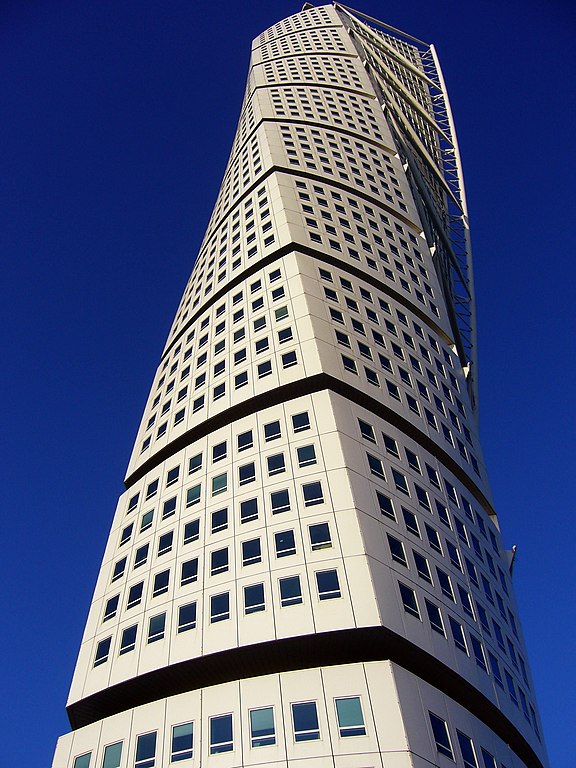
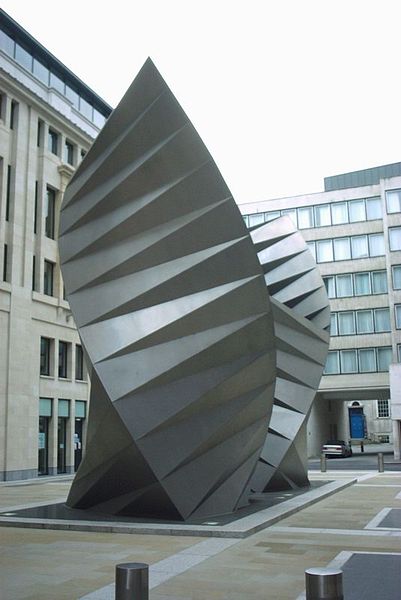
Public buildings are built in a neo-futurist style. Curves, twists, triangles, occasional things that look like alien space ships landed, buildings that must have been designed by people who idolized the Sydney opera house, overhangs, and a lot of glass. Mirrored glass, transparent glass. Frosted glass.
The mall is a work of glass and mirror smooth metal that avoids sharp corners and seems to operate on magic. You can't even see exactly where the light is coming from because if you could see the lights it would ruin the "operates on magic" atmosphere.
The trouble is, the city center as a whole was, kind of, designed by a barely functioning committee.
The architects were good at what they did, but they they weren't the ones who decided what went where. Yeah, some of it
looks like this, and the library's central area looks kind of
like this, and there are
smooth twisty buildings, but when it's placed alongside
this,
this, and
this... the effect is jarring.
Random other examples of the sorts of things you'd see in Centerville: a
bridge over air, a
bridge over water,
sculpture,
a bench, and
a museum.
That's from me randomly googling around.
-
The name was because it was supposed to be a place where all sorts of different people would come together. Different races, different politics, different class, different ethnicities, and so forth. It wouldn't be skewed in any direction. Thus, it would be at the center of all these things.
It was being planned and under construction during the 90's and America was already getting more and more partisan (government shutdowns, Clinton's impeachment, so forth) but even so those behind the project did not and could not see how bad things would get in terms of partisanship and ... everything else.
Fall 2004 is Lynn and co's junior year. That was the "Adam and Eve, not Adam and Steve" election.
Centerville is populated by people who have accepted, at least publicly the civil rights victories of the past. Open racists need not apply. (Other racists welcome.) But the civil rights issues of their present and future are ones where they're just as bad as anyone else.
-
The goal for economic diversity means that they've set things up so that no one goes hungry or homeless. Clothes, medical insurance, general spending money, cars, TVs, computers, phones, backpacks, books, and so forth weren't really taken into account.
It's part of why Lynn's poverty is well known in spite of the "everyone is equal here" rhetoric. It's not as if Centerville is a commie haven or anything. Poorer people being there is done via housing vouchers and stuff.
Part of what the Lynnverse is built on is pure unashamed class warfare. Lynn may live in a high tech (again, year 2000 standards) experimental community that's an attempt at utopia, but she's still poor and the kids at school always make sure she remembers it. The houses are the same regardless of class, the community was designed that way, but what's in the houses, what's in the driveway, what the residents wear... that's different.
Sometimes there's more month than there is food money. It pays to know that if you wear shirts two thick you can have holes in both without showing skin (just make sure the holes don't line up.) So on, so forth.
At least one of her villains, on the other hand, is a CEO of an evil incorporated business that's backed by, and accountable to, shareholders from Wallstreet.
Lynn may not be out to change the world (that's Zee's bailiwick, Lynn's mom's too) but she gets pulled into things because of her commitment to helping kids who ask her for help. If a kid is saying, "I'm going to lose my home because the park's rent is going up too much for my parents to pay," an Lynn will fight tooth and nail to help the (mobile) homeowners over the gouging landlords, and if it turns out that the gouging landlord is the company owned by her CEO villain then she'll go to war against the one percent because fuck the fucking fucker.
So that's part of it.
But then there's also the thing mentioned below about a child's freckles being stolen by a villain who wants to push their idea of physical perfection.
And there are agents of overblown conformity in other ways.
For example a recurring villain will be the Ge hivemind. ("ge" for "genetic experiment".) A handful of identical girls linked by a hive mind who think that everyone should be as perfectly in synch as they are with each other and thus be brought under the hive mind's control.
Things will start to get interesting with them when one of them gets out of synche, but that would probably happen slowly and not be a really noticeable thing until late in mythos some event pushed things passed the tipping point.
Then there's just a random grab bag:
A charming Irish tennis player who just happens to be a saboteur for hire.
A mercenary who does evil for highest bidder. Kidnapping? Check. Sabotage? She's better than the tennis player. Espionage? If the price is right, but since that tends to call for stealth the price has to be really good. She prefers things that begin, middle, or end with a car chase because what she really loves doing is turning cars into weapons (sometimes projectile in nature.) Occasionally a truck, but using a cement truck to take out a power plant really loses the appeal after the first six times. Been there, done that.
-
Quick note about the connection, insofar as there is one, to Kim Possible ↑
I'm not going to make any secret of the fact that portions of the Lynnverse come from thoughts about what
Kim Possible could have been but wasn't. Parts of the Lynnverse even pay homage to that. Why is Lynn a redhead who likes capris and crop tops? Because Kim.
Still, it's very much not
Kim Possible. There is both less and more focus on the "average girl" idea, for example.
Kim Possible, sometimes from the mouth of Kim herself, always insists that Kim is just an average girl who happens to save the world. Lynn would never link those two. Saving the world is hard, so much so that it's seldom something she sets out to do, and it takes a lot of work, a lot of dedication, talent most people don't have, and lots and lots of skill built upon that base of talent. Just like an Olympian isn't average, neither is a world saver.
On the other hand Lynn isn't at the top of the high school food chain, she isn't in every extracurricular club, she isn't popular without trying, she isn't ... all of the non-average power fantasy things that Kim is in her high school teenager life.
Lynn is at the bottom. One of the dregs. She lives in a "utopian" model community that is supposed to be free of class but somehow it's common knowledge that her family is the poorest in the community. Is it true? It doesn't matter. That she wears second hand clothes is all the "proof" that bullies need.
This spills over into the world saving bit. She doesn't get calls from top scientists or government officials working on top secret blah-dee blah. She has a website for children and teens who need a hand, and that causes her to stumble across nefarious plots. Sometimes the calls for help seem simple enough, sometimes they're downright weird. A tearful kid has had zir freckles stolen, Lynn discovers a plot to make everyone one jerk's idea of (physically) perfect which involves removing all "flaws" from unsuspecting people. Freckles got categorized as flaw.
And when she does get involved in the world saving she doesn't get taken seriously. A relic of a bond type villain who bemoans the lack of a worthy foe in this day and age does not see said foe provided to him in the form of Lynn. The fact that he's thwarted by a teenage girl is a source of embarrassment and no matter how many times she beats him he'll
never treat her as he would a worthy foe. She is beneath him and the fact that someone beneath him beats him is disgraceful.